
tl;dr
Early detection of disengagement is the most effective way to safeguard your organization’s health. By pairing annual Deep Dive surveys with frequent Pulse check-ins, you can monitor sentiment in real-time and identify subtle red flags like declining participation or quiet quitting patterns. Using benchmarks and importance graphs ensures your focus remains on the issues that truly impact your team. Ultimately, shifting from simple data collection to open communication and targeted action plans allows you to resolve challenges long before they lead to a final disconnect.
Why spotting disengagement early matters
Imagine driving a car and ignoring a strange, quiet rattling sound in the engine. You turn up the radio and keep driving. Eventually, the car breaks down on the highway. In business, that breakdown is the moment your top performer unexpectedly hands in their resignation.
But just like the car, the signs were there - you just had to know how to listen.
We often think of an employee leaving as a sudden event but the truth is, disengagement is rarely a snap decision. It is a slow drift. It’s the missed deadlines, the silence in meetings and the gradual withdrawal of enthusiasm.
By the time an employee physically leaves, they have likely been mentally checked out for months - so called quiet quitters. The key to retention isn't just solving problems when they become impossible to ignore, but identifying those subtle shifts in sentiment while there is still time to change the outcome.
Ignoring these early warning signs comes with a heavy price tag. This decrease in engagement triggers a costly domino effect that impacts the entire organization. According to Gallup, disengaged employees result in 37% higher absenteeism, 18% lower productivity, and 15% lower profitability. The goal is to shift from reactive damage control to proactive detection - stopping this cycle before it impacts your bottom line.

Signs of early disengagement
What does disengagement look like before an employee actually leaves? Often, it doesn't appear as drastic negative feedback, but rather as subtle patterns in the data. Here are the key warning signs to watch for:
- Declining response rates: Silence often speaks volumes. If a group of employees that typically participates in surveys suddenly stops responding, it is a significant indicator that they may be losing faith in the feedback process. Rather than assuming indifference, this should be recognized as a signal to reconnect, improve communication and demonstrate that their voice still matters.
- Teams shifting from "Engaged" to "Demotivated" Use data filters to monitor trends within specific departments or groups. If you notice a previously high-performing group dropping from "Engaged" to "Demotivated," this is a major red flag. Such a shift often points to a recent, localized issue - such as a change in management or increased workload - that requires immediate attention.
- The Quiet quitting phenomenon: Quiet quitting is characterized by employees doing the bare minimum and meeting only baseline job requirements. While they are not yet fully disengaged, they have stopped going "above and beyond". This is a critical early warning sign of emotional detachment. Identifying these patterns allows you to initiate feedback conversations and develop action plans to re-engage employees before they fully disconnect.
- Predictive analysis and hidden risks: This is where advanced tools like Luppa become essential. Beyond just measuring current sentiment, Luppa uses predictive analysis to identify future risks, such as burnout or a decline in psychological safety. By spotting these patterns early, you can provide the necessary support to employees before they reach the point of exhaustion or detachment.
How surveys help: More than just "collecting data"
Engagement surveys are a fundamental tool for understanding organizational dynamics. Yet, their effectiveness depends on a holistic approach that goes beyond simple data gathering. To accurately detect the layers of employee engagement and satisfaction, a survey strategy must be comprehensive - combining the right frequency with relevant context, industry benchmarks and a clear understanding of what truly drives your workforce. By integrating these elements, organizations can move from reactive measures to proactive insights.
Combine Pulse and Deep Dive
To really understand your team, you need two approaches. The Deep Dive survey is like an annual doctor’s appointment. It gives you a detailed report on the overall health of your company and highlights deep-rooted issues.
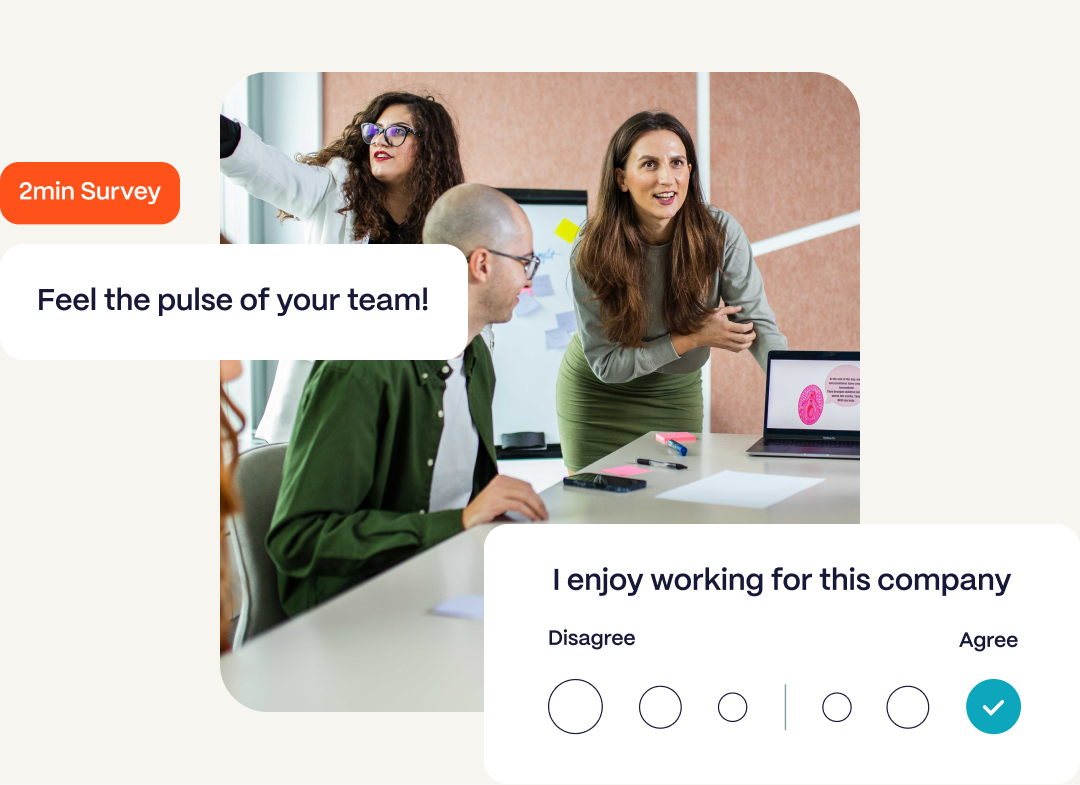
However, disengagement often happens gradually. That is where Pulse surveys come in. These are short, frequent check-ins — similar to a smartwatch tracking your daily activity. They allow you to monitor engagement trends in real-time. If you notice a sudden drop in a specific area, you can identify these early signs of disengagement immediately, instead of discovering the problem months later when an employee decides to leave.
The role of benchmarks
Data without context is meaningless. If your team achieves an engagement score of 3.8 out of 5, should you celebrate or panic?
Without industry and market benchmarks, you are essentially guessing. A score of 3.8 might be exceptional in the retail industry but a red flag in the tech market. Benchmarking allows you to understand the true meaning of your score - whether it signals a genuine internal crisis or simply reflects the norm for your specific industry and market. It prevents you from wasting resources fixing "problems" that are actually standard for your sector.
Prioritize based on what truly matters to employees
When survey results come in, the temptation is to try and fix every low score immediately. While the intention is good, this approach often leads to scattered efforts and limited impact. Not every low score requires immediate attention; addressing everything at once can dilute focus and limit the effectiveness of your actions.
Instead, the most effective approach is to prioritize based on what your employees consider truly important. This is where measuring importance alongside satisfaction proves its value. By asking employees to rate how much a certain aspect of work matters to them (not just how satisfied they are with it), you get a clear map of where to act first.
At Luppa, we use an Importance graph to visualize this, plotting two clear variables:
- Identify low priority issues: If "autonomy" scores low, but employees rate it as unimportant, it does not require immediate executive attention.
- Target key drivers: If "communication" scores low but is rated as highly important, this is a critical friction point that needs immediate action.
By using this method, you ensure that your energy is focused on the high-importance/low-satisfaction areas that truly drive engagement.
Strategic timing
Finally, the validity of your data depends heavily on when you ask the questions. As discussed in our recent blog Understanding response rates, timing is a strategic choice.
Launching a survey during the holiday rush, a quarterly closing, or a period of organizational restructuring can be counterproductive. Not only will the stress of the moment skew the data, leading to "false negatives”, but it can also damage trust. Asking for feedback when a team is already drowning feels tone-deaf. Respecting the operational rhythm of your business ensures that when you do ask for feedback, the team is ready to give it.
Now what? Post-Survey best practices

You have gathered the results. Now comes the most important part: turning that feedback into progress. One of the most effective ways to show employees that their voice matters is by moving from data collection to visible, meaningful action.
Speed is a strategy
Traditional reporting methods involving external experts can take one to two months, by which time the data is often outdated. Digital solutions provide real-time insights, allowing you to identify emerging trends and address issues the moment they arise. In the fast-paced modern workplace, the faster you see a problem, the faster you can resolve it.
Transparent communication
Sharing results openly builds trust and encourages participation in future surveys. Start by thanking employees for their input and providing a clear overview of both strengths and areas for improvement. When employees see that their feedback leads to measurable action plans and real change, they feel valued and appreciated.
Turning insights into measurable action plans
Once the results are communicated, the next step is to define concrete actions. Avoid vague goals like "improving teamwork." Instead, create specific, measurable action plans that address the pain points identified through your prioritization.
- Define ownership: Every action plan should have a clear owner and a deadline.
- Measure progress, not just activities: Don’t just track if a task is done, but whether it’s having the desired impact.
- Regular check-ins: Action plans shouldn't be "set and forget." Review them quarterly or monthly to see if they are still effective or if they need to be adjusted based on new feedback. This creates a loop of continuous improvement rather than a one-time fix.
Filtering and segmentation
A high company average can easily hide a struggling department or team. For example, work organization might look fine overall, but advanced filtering might reveal that a specific team is in crisis. Segmenting data by department, role, or location allows you to tailor solutions to the specific challenges of each group rather than implementing broad, ineffective changes.
Empowering leaders: The Manager view
Engagement is not solely an HR responsibility; managers are on the front lines of daily team dynamics. Providing managers with a dedicated view of their team's data allows them to identify concerns early and adjust their leadership approach accordingly. This localized ownership relieves the pressure on HR to distribute reports and ensures that those closest to the employees are the ones driving the culture. While HR provides the tools and framework, managers are the ones best positioned to build and maintain an engaged workforce.
Conclusion: From insight to action
Engagement surveys are far more than a tool for measuring numbers; they are the foundation for building a culture of open communication. By inviting employees to share their thoughts, you are signaling that their experience matters, which in itself is a powerful driver of engagement.
However, the true value of these insights lies in how you use them to protect your organization. Here is how to turn your survey data into a long-term retention strategy:
- Understand the financial impact: Disengagement is a quiet, expensive process. As we explored, ignoring the early signs can lead to a 18% drop in productivity and a 15% decline in profitability. For a deeper look at how these patterns affect your bottom line, read our previous blog, Why investing in engagement tools produces measurable ROI.
- Track trends in real-time: Move away from relying solely on annual snapshots. Instead, combine them with monthly Pulse surveys. While annual surveys provide the "big picture," monthly checks let you track sentiment in real-time. This mix allows you to catch the "rattling" of disengagement before it leads to a total breakdown.
- Be proactive, not reactive: By the time an employee reaches an exit interview, the opportunity to retain them has already passed. Proactive detection allows you to address hidden risks like burnout or quiet quitting while your talent is still part of the team.
Don’t wait for the resignation letter to ask what went wrong. By using surveys as a proactive listening tool, you can identify hidden risks like burnout or quiet quitting and address them today. Act now, listen closely, and transform your insights into a workplace where people truly want to stay.
Are you ready to see the numbers? Don't leave your ROI to chance - try our ROI calculator today to build a data-driven case for investing in your people.
Want to create a feedback culture where employees feel heard and engaged? Continue reading our blogs to learn more—or contact us to see how Luppa can help you drive participation, track sentiment, and turn insights into action.