
tl;dr
With global employee engagement dropping to just 21%, organizations face rising costs in turnover, lost productivity, and absenteeism. Investing in engagement tools is no longer an optional expense but a strategic move with a measurable Return on Investment (ROI). By leveraging digital analytics to drive targeted actions, companies can achieve 18% higher productivity and a 78% drop in absenteeism, transforming workforce culture into a driver of significant financial growth.
Introduction
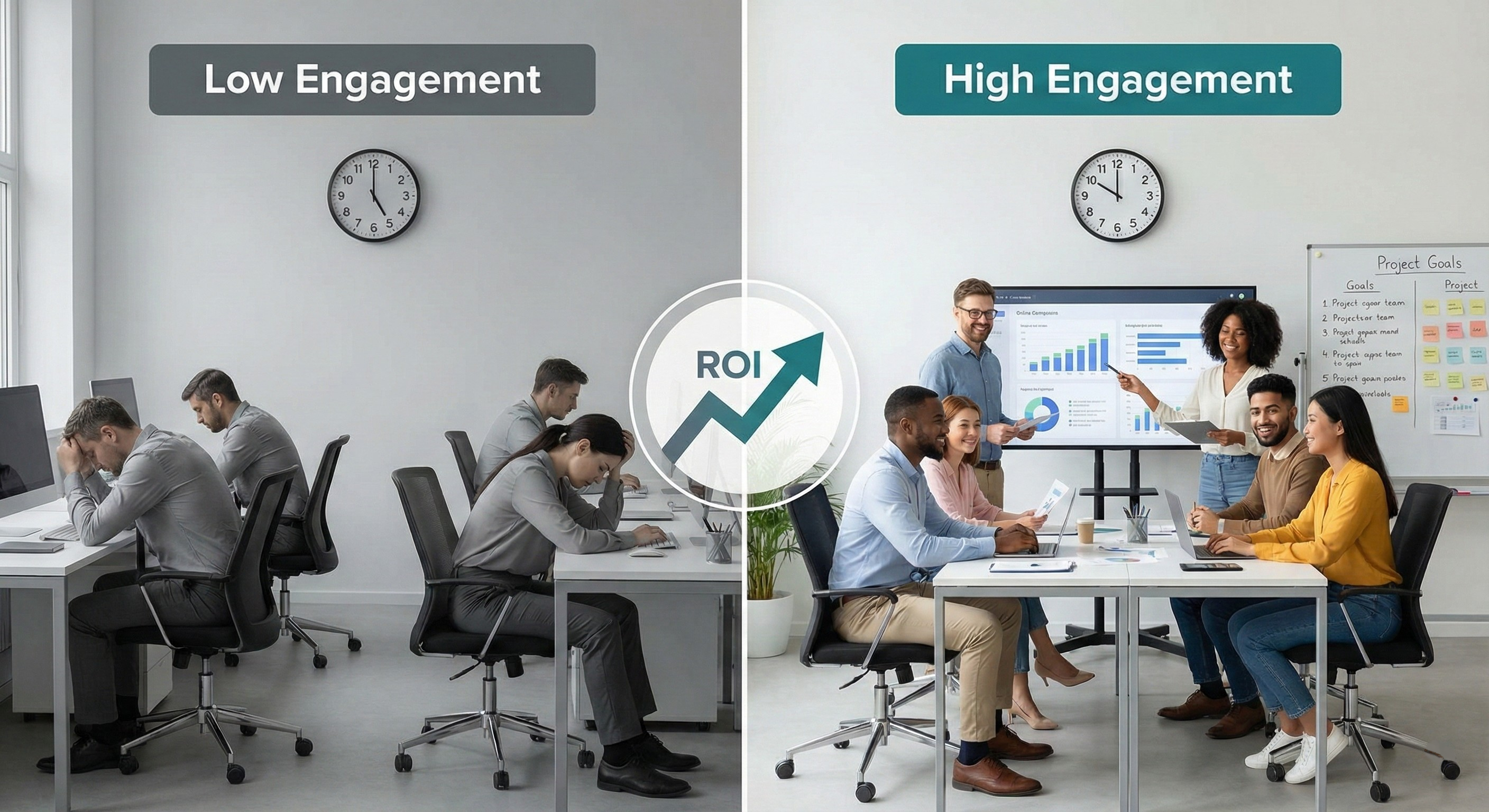
Imagine a team where most employees are fully committed to their work. Tasks are completed on time, collaboration feels straightforward and problems are solved before they escalate. Now, imagine the opposite, a team where engagement is low. Projects drag on, errors accumulate and motivation fades, affecting not just performance but the overall atmosphere in the workplace. These two scenarios aren’t abstract examples, they’re everyday realities that depend heavily on the level of employee engagement. Although the difference between them is clear, achieving the first scenario is becoming increasingly difficult.
Employee engagement continues to be a critical challenge for organizations worldwide. In 2024, only 21% of employees globally reported feeling engaged at work, down from 23% the previous year. In Europe, the situation is even more concerning, with just 13% of employees feeling engaged (Gallup, 2025). Low engagement affects productivity, retention, and overall business performance, making it a priority for companies that want to thrive.
So why does engagement matter? Simply put, engaged employees are more productive, more loyal and more likely to contribute to the success of the organization. This makes investing in engagement not a cost - but a strategic investment with measurable ROI.
What factors shape ROI?
To understand the financial impact of engagement initiatives, we need to move from intuition to equations. How do we actually calculate the return on engagement programs?
While ROI might seem abstract at first, it is grounded in concrete, measurable metrics.
The key factors to consider include:
- Company Size: The total number of employees, which determines the scale of impact.
- Company average annual employee cost: A key driver of cost and savings calculations.
- Employee fluctuation: Your organization’s current turnover rate.
This is where specialized employee engagement and satisfaction tools, such as Luppa, become essential. Beyond just gathering feedback, these tools provide robust analytics that help quantify the value of your workforce.rganizations focus on creating supportive environments that address these deeper challenges.
Features like Luppa’s ROI calculator take this analysis a step further. They use company-specific inputs to generate a precise financial case for investment. By combining internal data — such as employee turnover, productivity, and engagement levels — with the calculator, organizations can see exactly how improvements in engagement translate into measurable business outcomes.
Here is a detailed breakdown of how engagement directly impacts the three key areas of business expense.
Turnover costs decrease
Employee turnover is often the most visible cost of disengagement. When an employee leaves, the financial hit is immediate and substantial.
Replacing a team member is incredibly expensive. Estimates suggest that the cost of replacing an employee ranges from 30% to 50% of their annual salary. For highly specialized or senior roles, that figure can skyrocket to 150% (Nailted, 2024). These costs are not just about recruitment fees; they include the time spent on interviewing, onboarding, training and the "ramp-up" period where a new hire is not yet fully productive. During this phase, you are essentially paying a full salary for partial output, while simultaneously diverting the attention of your high-performers who need to step away from their work to mentor the new arrival.
The urgency to address this is real. In 2024, 68% of companies experienced higher turnover than expected, and perhaps most alarmingly, 61% of employees left jobs within the first 12 months of hiring (Second Talent, 2025). This implies that for many companies, the investment in recruitment and training walks out the door before it ever generates a return.
Furthermore, high turnover damages the morale of the remaining team, often leading to a domino effect of further resignations.
There is a direct correlation between how people feel and how long they stay. According to Gallup, high-engagement teams typically experience turnover rates that are 18% to 43% lower than teams with low engagement.
The ROI: By investing in tools that analyze engagement, you gain the insights needed to create targeted action plans. Addressing the root causes of turnover with data-driven interventions allows you to actively protect your retention rates. This strategic approach saves on recruitment fees, minimizes the disruption of onboarding and retains valuable internal expertise. Every employee you don't have to replace is money directly added back to your budget.
Productivity increases
There is a distinct difference between an employee who is merely "present" and one who is "engaged." Disengaged employees may do the bare minimum to get by — a trend often referred to as quiet quitting — but engaged employees bring discretionary effort to the table. They work smarter, not just harder.
Engaged employees take ownership of their roles. They are proactive in solving problems, more innovative in their approaches and more aligned with the company's strategic goals. They don't just occupy a seat; they drive the business forward.
The financial impact of this "discretionary effort" is measurable. Research shows that companies with high employee engagement see an 18% increase in productivity compared to those with low engagement levels (Gallup).
The ROI: Think of this in terms of resource allocation. An 18% boost in productivity means your existing workforce can achieve the output of a significantly larger team - without the overhead costs of hiring additional staff. Engagement and satisfaction tools such as Luppa essentially allow you to unlock "hidden" capacity within your current workforce, optimizing performance and sustaining business growth without inflating your payroll.

Absenteeism rates drop
Absenteeism is a silent profit killer. We aren't talking about legitimate illness, but rather the unplanned absences often triggered by stress, burnout, or a simple lack of motivation to face the workday.
These unexpected absences disrupt workflows, delay project timelines and place an unfair burden on the colleagues who have to pick up the slack. This increased pressure on the remaining team often leads to a cycle of burnout, creating even more absenteeism in the future.
Engagement is the best defense against burnout. The data is unequivocal: teams with high engagement levels see a massive 78% decrease in absenteeism (Gallup, 2025).
The ROI: Reducing absenteeism helps you reclaim costs previously lost to inefficiency. When employees feel supported, valued, and connected to their work, they show up. A reduction in unplanned leave means better operational continuity and a more stable, resilient workforce. You are effectively stopping money from leaking out of the organization due to stress-related downtime.
How HR tools can improve employee engagement
Achieving the savings mentioned above - lower turnover, higher productivity, and reduced absenteeism, requires more than just guesswork or an annual "suggestion box." To see real results, you need a strategy driven by precise data.
This is where digital tools revolutionize the process.
Moving beyond assumptions In the past, leaders often relied on intuition to gauge the mood of the office. However, in today's complex, often hybrid work environments, intuition is not enough. To truly understand the heartbeat of your organization, you need concrete analytics to guide your decisions.
The role of analytics This is where digital tools revolutionize the process. Platforms like Luppa are designed to bridge the gap between employee feedback and management action, empowering organizations to gather real-time feedback and transform it into actionable analytics.
Using advanced employee engagement and satisfaction tools allows you to focus on three key areas:
- Actionable insights: Effective tools don't just collect data; they highlight specific areas of concern, allowing you to spot negative trends early - before they turn into resignation letters.
- Benchmarking: Context is key. Tools such as Luppa allows you to compare your engagement metrics against industry and market standards. Knowing whether you are leading or lagging behind your competitors helps you set realistic goals and prioritize your efforts. Learn more about the science behind the Luppa benchmark system.
- Targeted action plans: The ultimate goal of data is action. With detailed reports, HR and management can create specific, targeted interventions that address the root causes of disengagement.
By using digital tools, you aren't just measuring the problem; you are actively managing the solution that leads to the ROI.
The price of disengagement
When you step back and look at the cumulative effect of these factors, the business case is undeniable.
Lower turnover + Higher productivity + Fewer absences = Significant business growth.
Investing in engagement tools is not about "buying happiness." It is about building a more efficient, resilient, and profitable organization. It creates a workplace where employees are satisfied and healthy, which in turn drives better business results.
The cost of doing nothing is too high. It’s time to stop guessing about the state of your workforce and start calculating the value of your people.
Are you ready to see the numbers? Don't leave your ROI to chance - try our ROI calculator today to build a data-driven case for investing in your people.
Want to create a feedback culture where employees feel heard and engaged? Continue reading our blogs to learn more—or contact us to see how Luppa can help you drive participation, track sentiment, and turn insights into action.